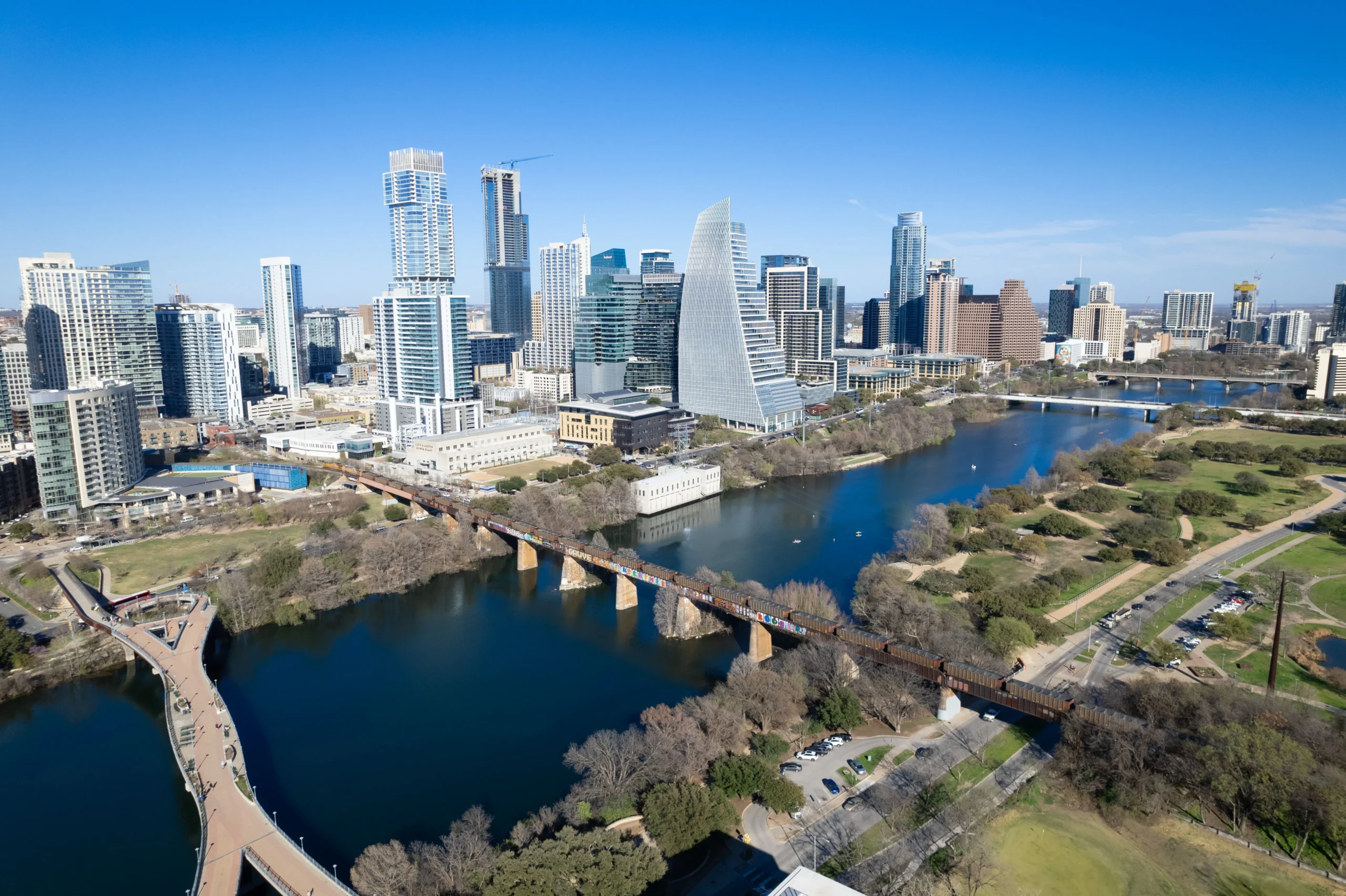
Austin, Texas, doesn’t need much of an introduction. The Live Music Capital of the World. Silicon Hills. Home of the Longhorns. The city that told you to keep it weird before weird was a brand.
What Austin does need is an honest one. Because the city that people arrive expecting and the city they actually live in are sometimes two different places.
The food trucks are real. The music is real. The 100-degree summers, the I-35 traffic, and the property tax bills are also real. People who move here knowing all of that tend to love it. People who show up only for the postcard version are sometimes surprised.
Here’s what we know after years of moving families into and out of the Austin metro: this city earned its reputation. It also comes with trade-offs worth understanding before moving day.
We’ve been part of the Austin moving landscape for years. Our crews know every neighborhood, every quirky downtown loading situation, and exactly how long it takes to get a truck across town on a SXSW weekend.
Let us give you the real picture.
Why People Are Moving to Austin, TX
The growth speaks for itself. Austin has added more than 150 people per day in recent years, making it one of the fastest-growing major metros in the country. The reasons run deeper than the brand.
What’s Driving Growth
Austin’s tech economy is the engine. Apple, Google, Tesla, Oracle, Meta, and Amazon all have significant presences in Austin. More than 1,800 businesses have relocated to the region in recent years.
The tech sector has cooled somewhat from its pandemic-era peak, and the information sector has contracted over the last two years as companies right-sized post-hiring surge. But the foundation is strong, and Austin’s diversified growth across healthcare, education, government, and professional services has kept the job market resilient.
The University of Texas at Austin anchors the local education economy with roughly 50,000 students and one of the most influential alumni networks in the country. UT is consistently one of the top public research universities in the US and a major employer in its own right.
Texas has no state income tax, which remains one of the most powerful draws for high earners relocating from California, New York, and other high-tax states.
The trade-off is property taxes.
Travis County’s effective rate runs approximately 1.8-2.5% of assessed value, and the county raised rates 9.12% in 2025 following major flooding. On a $500,000 home with a homestead exemption, expect $8,000-$10,000, or more, annually in property taxes.
File your homestead exemption as soon as you close.
Quality of Life Factors

The job market spans tech, healthcare, government, education, and a creative economy that doesn’t exist at this scale in most cities. Austin’s average salary runs around $87,000, with an unemployment rate near 3.6%. High-growth sectors include healthcare, cybersecurity, semiconductor design, and professional services.
Outdoor recreation is exceptional for a major metro. Barton Springs Pool is a spring-fed swimming hole inside the city limits that stays 68-70 degrees year-round. Lady Bird Lake draws kayakers, paddleboarders, and runners along its 10-mile hike-and-bike trail.
Barton Creek Greenbelt offers 12+ miles of trails through the Hill Country terrain directly accessible from South Austin. And the broader Highland Lakes system, including Lake Travis and Lake Austin, gives residents world-class boating and swimming within 30 minutes of downtown.
The cost of living in Austin has moderated since the pandemic peak. Median home prices have pulled back from highs above $600,000 and now sit in the $530,000-$577,000 range, which remains elevated.
The overall cost of living runs roughly 3-19% above the national average, depending on the measure, with housing as the primary driver. Rents have declined meaningfully since 2022 as supply caught up with demand, with two-bedroom apartments now averaging $1,700-$1,900 in the city and more affordable options in the suburbs.
Food and culture are what set Austin apart from almost any other city of comparable size. More than 250 live music venues operate in Austin at any given time. Sixth Street, East 6th, and the Red River Cultural District provide live music every night of the week. The food truck ecosystem is among the densest in the country, and sit-down options range from Franklin Barbecue (worth the line) to some of the best Tex-Mex on the planet. SXSW in March and ACL Festival in October are world-class cultural events that just happen to be in your backyard once you live here.
What Are the Best Neighborhoods in Austin, TX?
Austin is a sprawling city of 271 square miles, and the neighborhood you choose will shape your daily life more than almost any other decision you make in the move. Austin’s traffic is notoriously bad, and living close to where you work matters.
South Congress (SoCo): Austin in Postcard Form
Character: The most iconic stretch in Austin outside of 6th Street, SoCo is a walkable mile of local boutiques, taco stands, vintage shops, live music, and electric street energy. This stretch of South Congress instantly puts people under ATX’s thrall. The residential streets surrounding it are a mix of craftsman bungalows and newer infill construction.
Median home price: $650,000-$900,000+
Who lives here: Creatives, young professionals, remote workers, and people who decided that the Austin character is worth paying for. SoCo draws people from all over the country who specifically researched Austin’s neighborhoods and landed here first.
What makes it special:
- South Congress Avenue: The heartbeat of Austin’s independent retail and dining culture; First Thursday block parties turn the street into an outdoor festival monthly
- Barton Springs access: Walking or biking distance to one of the great urban swimming holes in the country
- Zilker Park: 361 acres of green space adjacent to the neighborhood; home to ACL Festival twice each October
- Walkability: Among the highest Walk Scores in Austin; car-optional for daily errands near the core
Worth knowing: SoCo prices reflect the demand. Entry-level single-family homes are rare; the more realistic options are condos, townhomes, or older bungalows with significant deferred maintenance. And the neighborhood is busy, which is the point, but it means noise and parking competition are daily realities.
Mueller: The Master-Planned Neighborhood Austin Did Right
Character: Built on the site of the old Mueller Airport, this 700-acre planned urban community is one of the best-executed new urbanist developments in Texas. Walkable for daily errands, with a town center, farmers market, parks, and a mix of housing types designed from the ground up for livability.
Median home price: $550,000-$800,000
Who lives here: Families, young professionals, and people who want the benefits of urban living (walkability, community, proximity) without the chaos of the densest Austin neighborhoods. Mueller consistently tops “best Austin neighborhoods” lists for a reason.
What makes it special:
- Mueller Town Center: Grocery, restaurants, coffee, fitness, and retail within a five-minute walk for most residents
- Thinkery Children’s Museum: One of the best children’s museums in Texas, located inside the neighborhood
- Girard Kinney Park: 30+ acres of urban green space with hike-and-bike trails and a butterfly garden
- Diversity of housing: Townhomes, single-family, condos, and affordable units mixed throughout, which produces a more diverse and interesting neighborhood than most Austin developments
- UT and Dell Medical School access: Walking distance or short bike ride
Worth knowing: Mueller’s popularity means inventory is tight and prices have appreciated faster than most of Austin. Some residents find the planned community feels a little manicured. It rewards people who value infrastructure over vintage character.
East Austin: Creative Energy and Rising Prices
Character: East Austin was one of Austin’s most affordable neighborhoods and historically a center of Austin’s Black and Latino communities. Over the past 15 years, though, East Austin has undergone a significant transformation. Today, it’s a hipster paradise. A dense mix of food halls, coffee shops, murals, craft breweries, and bungalow homes, with some of Austin’s best restaurants concentrated along E. 6th Street and the surrounding blocks.
Median home price: $550,000-$750,000
Who lives here: Young professionals, creatives, tech workers who want proximity to downtown, and longtime residents who have stayed through the neighborhood’s evolution. East Austin draws people who want urban energy without the tourist density of 6th Street.
What makes it special:
- Restaurant and bar concentration: Some of Austin’s best independent food and drink, from Nixta Taqueria to Whisler’s to Lazarus Brewing
- Street art and murals: The neighborhood has one of the most photographed public art collections in Austin
- Bike-friendliness: More protected bike lanes than most Austin neighborhoods; close enough to downtown to make biking viable
- Proximity: Short drive or bike ride to downtown, UT, and major employers
Worth knowing: East Austin’s transformation has priced out many longtime residents. The neighborhood is an actively contested territory regarding housing affordability. Parking is difficult; many streets are narrow. And, the energy that makes it attractive on weekends is the same energy that makes it loud on Thursday through Saturday nights.
Tarrytown / Clarksville: Old Austin Money and Character
Character: Two adjacent west-side neighborhoods that represent Austin’s most established residential addresses. Large lots, mature trees, mid-century and older architecture, and proximity to Lake Austin give Tarrytown and Clarksville a character that newer developments can’t replicate. This is where Austin’s old guard lives.
Median home price: $900,000-$1.5M+
Who lives here: Established professionals, executives, long-time Austin families, and buyers who have specifically decided that character and location justify the price premium. These neighborhoods have the best resale value in Austin.
What makes it special:
- Lake Austin access: Some streets have direct lake frontage; the broader neighborhood is minutes from boat ramps and Lake Austin waterfront restaurants
- Deep Eddy Pool: One of the oldest swimming pools in Texas, a neighborhood institution
- School access: Eanes Independent School District is one of the most sought-after in the Austin metro, and Tarrytown is split between Austin and Eanes ISDs
- Tree canopy: The mature live oaks and elms that line the streets took decades to grow; you won’t find this in new construction
Worth knowing: Entry into Tarrytown and Clarksville at a reasonable price point is difficult. Most buyers in this range are trading up from elsewhere in Austin or coming from out of state with significant equity. Flood zones exist in lower-lying Clarksville areas; check FEMA maps carefully.
Round Rock / Cedar Park / Pflugerville: Suburban Value Near the City
These three suburban cities north and northeast of Austin function as the metro’s family-friendly, more affordable alternative to Austin proper. Each has its own identity but shares common traits: newer construction, larger lots, strong schools, and price points that make homeownership significantly more attainable.
Median home price: $380,000-$520,000
Who lives here: Families with school-age children, tech workers at Dell (Round Rock HQ) or the Domain corridor, and buyers who’ve done the math and decided that the commute trade-off is worth the savings.
What makes it special:
- Round Rock ISD and Leander ISD: Both consistently rank among the top school districts in Texas
- Dell Technologies campus (Round Rock): Major employer that makes Round Rock a short commute or no commute for a significant tech workforce
- The Domain (North Austin): The metro’s second major employment and retail corridor, accessible from all three suburbs
- Value: Comparable quality of life to many Austin zip codes, at 25-35% less in housing costs
Worth knowing: The commute to downtown Austin from all three can be 45-60 minutes during peak hours on MoPac or I-35. If you’re downtown-bound daily, factor this into the calculation. The CapMetro Red Line commuter rail connects Round Rock and Cedar Park to downtown Austin, offering an alternative to driving.
Other Neighborhoods of Note
Hyde Park: Historic central Austin neighborhood north of UT with craftsman bungalows, a tight-knit community, and the best tree canopy in central Austin. Popular with UT faculty and longtime Austinites.
The Domain / North Austin: Not a traditional neighborhood but Austin’s second city center, with major employers, luxury apartments, and high-end retail in a walkable corridor. Popular with tech workers who don’t need or want to be downtown.
Bee Cave / Lakeway: Western suburbs with Hill Country character, Lake Travis access, and top-rated Lake Travis ISD. Popular with families willing to trade a longer commute for lake life and lower density.
Ready to Move? We've Got You Covered.
Whether you're ready to book or just have questions, we're here to help.
What Is the Cost of Living in Austin, TX?
Austin’s cost of living has pulled back from pandemic highs but remains above the national average, primarily driven by housing.
| Category | Austin | Dallas | National Avg |
|---|---|---|---|
| Median home price | ~$530K-$577K | ~$380K-$440K | ~$420K |
| State income tax | None | None | Varies |
| Average rent (2BR) | ~$1,700-$1,900/mo | ~$1,400-$1,700/mo | ~$1,700/mo |
| Property tax rate | ~1.8-2.0% (Travis Co.) | ~2.0-2.4% (varies) | ~1.0% |
| Overall cost of living | ~3-19% above national avg | Near national average | Baseline |
Two things that don’t show up in these numbers deserve a mention.
First, Texas’s lack of state income tax is a significant financial advantage for anyone coming from California, New York, or Illinois. For a household earning $150,000, annual tax savings can be $8,000 to $15,000 or more.
Second, Travis County property taxes are among the highest effective rates in the country. File your homestead exemption immediately after closing; it can reduce your taxable value by $100,000 for school district taxes under current Texas law.
What to Know Before Moving to Austin, TX

I-35 and Austin Traffic
Austin’s traffic is a daily consideration and not an exaggeration.
- I-35 through central Austin is one of the most congested stretches of interstate in Texas; avoid it between 7-9 am and 4:30-7 pm if you have any flexibility
- MoPac (Loop 1) is the western alternative and often faster for north-south travel, but it backs up at the Loop 360 interchange during peak hours
- Plan your move to start before 7 am on weekdays to avoid both corridors at their worst
- Same-day downtown moves should plan for limited loading zone access; coordinate with your building management well in advance
Downtown and High-Rise Logistics
Austin’s downtown is increasingly dense with high-rise residential buildings, and they come with specific requirements:
- Certificate of Insurance (COI): Most downtown buildings require your mover to carry $1-2M in liability coverage; coordinate this 1-2 weeks before your move date
- Service elevator reservations: Required at most high-rise buildings; book 2-4 weeks out and confirm business-hours-only restrictions
- Parking and loading: Downtown Austin has limited dedicated loading zones; the Rainey Street and 2nd Street corridors are the smallest. Your crew will coordinate, but build extra time into your schedule.
UT Move-In (Late August)

The University of Texas brings roughly 50,000 students back to campus in the third and fourth weeks of August. The effects radiate well beyond campus:
- Guadalupe Street (The Drag), West Campus, and North Campus corridors become essentially impassable during move-in weekend
- I-35 north of the river backs up badly with move-in traffic combining with regular congestion
- Hyde Park and North Loop neighborhoods adjacent to UT are also significantly affected
SXSW (March)
South by Southwest is one of the great festivals in the world. It is also two weeks during which downtown Austin is effectively inaccessible by large vehicles:
- Avoid scheduling downtown moves during SXSW (typically the second and third weeks of March)
- Loading zones, parking garages, and streets are occupied by festival infrastructure and redirected traffic
- Even moves in adjacent neighborhoods east of I-35 and south of the river feel the downstream effects
Flood Awareness
Austin’s July 2025 floods were catastrophic, triggering a 9.12% property tax increase in Travis County to rebuild emergency reserves. Flash flooding is Austin’s most significant natural hazard:
- Nine percent of Austin properties face severe flood risk over the next 30 years
- Check FEMA flood maps before signing or buying, especially near Waller Creek, Shoal Creek, or any tributary of Lady Bird Lake
- Barton Creek Greenbelt and surrounding neighborhoods have flooded historically; understand your specific parcel’s risk
Moving Calendar: When to Move (and When to Avoid)
Best Times
- November-February: Austin’s winters are mild and short; this is the best window for a comfortable move at lower cost. Cold fronts can bring temperatures into the 30s and 40s, but rarely disrupt a move. Availability is high, and pricing reflects it.
- March (before SXSW): The first week of March is a strong window; after that, downtown is increasingly affected by festival staging.
- May (after UT finals): Post-graduation, pre-summer heat, and before the summer moving rush peaks. A brief but good window.
- Weekdays: Always preferable; building elevator access, loading zones, and traffic are all more manageable Monday through Thursday.
Times to Avoid
- SXSW (March, weeks 2-3): Downtown and adjacent neighborhoods are festival territory.
- Late August (UT move-in): The worst window of the year for central Austin moves.
- June-September peak heat: Austin summers are severe. Consistent 95-105 degrees from June through September, with the heat island effect making central neighborhoods several degrees hotter. Budget $200-$400 per month for electricity from June through August.
- ACL Festival weekends (October, Zilker Park): Two back-to-back weekends in October; the area south of Lady Bird Lake and around South Congress becomes extremely congested.
- Formula 1 US Grand Prix (October, Circuit of the Americas): COTA is in southeast Austin, and race weekend significantly affects I-35 and Highway 71.
Things to Do in Austin, But Maybe Not on Moving Day
- SXSW (March)
- Austin City Limits Music Festival (two weekends in October, Zilker Park)
- Formula 1 US Grand Prix (October, COTA)
- UT Longhorns home football (Saturdays, September-November; Darrell K Royal Stadium and surrounding streets)
- Austin Marathon (February; downtown road closures)
Frequently Asked Questions About Moving to Austin, TX
Is Austin, TX, a good place to live?
Yes, for the right person. Austin offers an exceptional job market, a world-class live music and food scene, outstanding outdoor recreation, and the financial advantages of Texas’s no-income-tax environment. The trade-offs are real: cost of living above the national average, brutal summers, heavy traffic, and property taxes among the highest in the country. People who go in with clear eyes tend to love it.
How expensive is it to live in Austin?
Austin’s overall cost of living runs approximately 3-19% above the national average, depending on the measure, with housing as the primary driver. Median home prices range from $530,000 to $577,000; two-bedroom apartments average $1,700 to $1,900 per month in the city. Suburban options in Round Rock, Cedar Park, and Pflugerville are significantly more affordable. Texas has no state income tax, which offsets some of the housing premium for higher earners.
What is Austin, TX, known for?
Austin is the capital of Texas and home to the University of Texas. It’s internationally known as the Live Music Capital of the World, home to SXSW and ACL Festival, and one of the country’s leading tech hubs with major presences from Apple, Google, Tesla, Oracle, and Meta. It’s also known for Barton Springs, Lady Bird Lake, an exceptional food truck and BBQ scene, and the “Keep Austin Weird” ethos that still shapes the city’s independent business culture.
What are the best neighborhoods in Austin for families?
Mueller, Round Rock, Cedar Park, and the Bee Cave/Lakeway area are consistently the strongest choices for families, offering strong school districts, community infrastructure, and more attainable price points than central Austin. Families prioritizing schools specifically should research Eanes ISD (Westlake area), Round Rock ISD, and Leander ISD, all of which rank among the top districts in Texas.
Is Austin still growing?
Yes, though the pace has moderated from the pandemic surge. Austin has been adding roughly 150 people per day and remains one of the fastest-growing major metros in the country. Domestic migration has slowed somewhat as prices have risen and the tech hiring boom has normalized, but the long-term growth fundamentals remain strong.
When is the best time to move to Austin?
November through February and the first week of March offer the best combination of mild weather, lower demand from moving companies, and better pricing. Avoid late August (UT move-in), the March SXSW window, and the June-September heat peak.
Let Little Guys Movers Make Your Austin Move a Cinch
We’re biased. We think Little Guys is the best choice when moving to Austin. Whether you’re landing a tech role, relocating from the coasts for a better cost-of-living equation, or simply ready to find out what Austin living actually feels like from the inside, we’re committed to making your move as smooth as possible.
Our crews know I-35, the SXSW calendar, the COI requirements at downtown high-rises, and how to navigate a loaded truck through Hyde Park on a UT football Saturday. We’re happy to walk you through any of it before moving day.
From the team at Little Guys Movers. Welcome to Austin.
Ready to Move? We’ve Got You Covered.
Whether you’re ready to book or just have questions, we’re here to help.
Ready to Move? We've Got You Covered.
Whether you're ready to book or just have questions, we're here to help.